Wednesday, January 03, 2007

FNTI’s Indigenous Communications Department Presents


Improving Indigenous Communications

New and better ways to communicate with each
other, and generate more and more realistic stories by the news media.

Rob Henderson Vice-President of CNW Group, part of the world’s largest communications network. It is vital to improve communications given recent developments in land rights and other issues.

Question and answer period to follow.
Everyone is welcome


Wednesday, January 10, 2007
2 - 4 p.m.
Community Centre, Old York Road
(next to Mohawk Fair Grounds)
Refreshments provided

Tuesday, December 05, 2006

FNTI’s Bachelor of Social Work graduating students

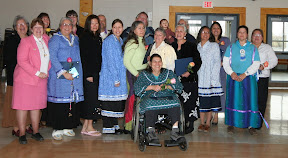
FNTI’s Bachelor of Social Work graduating students and FNTI and Ryerson University faculty members took part in a Completion Ceremony in London, Ont. on Nov. 30. Family members attended the dinner, ceremony and a social. Thirteen class members will graduate at Ryerson June 14.

Friday, December 01, 2006

Ottawa cuts spending on Indigenous languages in Canada


BUS LEAVING MOHAWK COMMUNITY CENTRE
8:00am
Tuesday, December 5th, 2006

The demonstration will start at the Westin Hotel,
11 Colonel By Drive, Ottawa, Ontario,
then will proceed to Parliament Hill.

For More Information:

Callie Maracle, Coordinator
(613) 396-3100 x 227


$5 per person to help with expenses

Funding cut story


Thursday, November 23, 2006

Tontakaiê:rine ( It has become right again,) Tyendinaga Justice Circle, Restorative Justice Program


The TJC is currently being run through First nations Technical Institute with a satellite office maintained at the Tyendinaga Police Station. The TJC is an alternative to the current justice system, with a focus on youth from 12-17 years of age. The circle consists of community members who have taken the initiative to become involved. Not to be confused with the ‘Sentencing Circle”, the forum brings together victims, offenders and their supporters in a safe, controlled environment to discuss the offence and its effect and to jointly decide how to right the wrong that has been done. The Objective of the TJC is to return to a traditional form of justice. This process can be recognized as a proactive strategy to empower the community to regain their perspective roles of respect.

What is Restorative Justice

Restorative Justice can be seen as a set of principles which guide agencies and practitioners rather than a particular practice. It offers alternative ways of thinking about crime by emphasizing the harm crime does to the community, and how the community rather that the court system can respond to crime in more satisfactory ways. It may incorporate a variety of approaches, applied at various stages of the criminal justice process, i.e. Pre-charge and post charge cases. Restorative justice places an emphasis on all those involved in an offense – victims, offenders and the community – and seeks to reconcile, restore and repair relationships and situations.


Indigenous Perspective

In First Nations community justice projects, communities develop their own models that in varying degrees incorporate the traditional, spiritual and cultural practices that will best serve their specific community needs based on their cultural understanding of justice concepts. They embody traditional practices associated with first Nations justice appropriate to each community. Offending behavior is viewed in the context of both contemporary and historic circumstances that include the inter-generational affects of attendance at residential schools and impact of colonialism in respect to traditional Indigenous practices. Depending on the particular circumstances and community practices, aspects of spiritual ceremonies may or may not be incorporated into a community justice process.


Contact Numbers

Office located at First Nations Technical Institute 613-396-2122 ext 123
Tyendinaga Police Dept. 613-967-3888

Friday, November 17, 2006

FNTI instructor recieves award

Rick Hill, MA, left, of FNTI’s Indigenous Community Health Approaches program, received the Aboriginal Institutes’ Consortium (AIC) Faculty Achievement Award for his teaching and mentorship from FNTI President Karihwakeron Tim Thompson. "Rick inspires students to think critically and empowers them to gain control over their learning and educational path," said program manager Suzanne Brant. .Hill received the award at graduation ceremonies for the program on Six Nations Territory in November.

Indigenous Community Health Approaches Program Graduation

Graduating class of 2006 included: Audrey Anderson, Wanda Antone, Cindy Carpenter, Cindy Ecker-Flagg, Kim Henry, Betty Maracle, Cindy Martin, Dawn “Bloss”, Shani Martin, Alberta Monture, Gail Whitlow, Shani Martin, Alberta Monture, Gail Whitlow, Amy Williams

First Nations Technical Institute (FNTI) graduation was held on November 10, 2006 for Six Nations residents who successfully completed the Indigenous Community Health Approaches program that was delivered at the Grand River Territory over the last year. The learners were awarded an Indigenous Community Health approach Program (post-diploma) graduate certificate.

The Indigenous Community Health Approaches program explores Indigenous knowledge and philosophies as they relate to human health and the natural environment. The program is rooted in Indigenous knowledge and exposes First Nations health professionals to cultural teachings which broaden their understanding about health, health care and environmental and human health issues facing First Nations communities.

This one-year graduate certificate (post-diploma) program provided the First Nations health professional with the opportunity to acquire new skills and understandings. The program of study outlines how cultural knowledge can be applies in resolving health issues facing First Nations communities, while creating opportunities for enrichment of their own personal cultural knowledge.

The program consists of twelve courses totaling 600 hours of study. The program is offered through a partnership agreement between First Nations Technical Institute (FNTI) and St. Lawrence College of Applied Arts and Technology.

Instructors for the course include: Suzanne Brant and Janice Brant, both from Tyendinaga Mohawk Territory; as well as Norma General, Dan Longboat and Rick Hill, all from Six Nations.

The graduation ceremony took place Friday, November 10, 2006 at the Six Nations Community Hall.

Tuesday, November 14, 2006

Innoversity Summit in Toronto

Tiar Wilson, an FNTI media student who has done internships at CTV Sudbury and APTN in Winnipeg, used her skills as a video journalist to report from the recent Innoversity Summit in Toronto.