 |
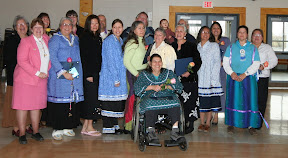
| FNTI’s Bachelor of Social Work graduating students and FNTI and Ryerson University faculty members took part in a Completion Ceremony in London, Ont. on Nov. 30. Family members attended the dinner, ceremony and a social. Thirteen class members will graduate at Ryerson June 14. |
Tuesday, December 05, 2006
FNTI’s Bachelor of Social Work graduating students


Friday, December 01, 2006
Ottawa cuts spending on Indigenous languages in Canada

BUS LEAVING MOHAWK COMMUNITY CENTRE
8:00am
Tuesday, December 5th, 2006
The demonstration will start at the Westin Hotel,
11 Colonel By Drive, Ottawa, Ontario,
then will proceed to Parliament Hill.
For More Information:
Callie Maracle, Coordinator
(613) 396-3100 x 227
$5 per person to help with expenses
Funding cut story
Thursday, November 23, 2006
Tontakaiê:rine ( It has become right again,) Tyendinaga Justice Circle, Restorative Justice Program

The TJC is currently being run through First nations Technical Institute with a satellite office maintained at the Tyendinaga Police Station. The TJC is an alternative to the current justice system, with a focus on youth from 12-17 years of age. The circle consists of community members who have taken the initiative to become involved. Not to be confused with the ‘Sentencing Circle”, the forum brings together victims, offenders and their supporters in a safe, controlled environment to discuss the offence and its effect and to jointly decide how to right the wrong that has been done. The Objective of the TJC is to return to a traditional form of justice. This process can be recognized as a proactive strategy to empower the community to regain their perspective roles of respect.
What is Restorative Justice
Restorative Justice can be seen as a set of principles which guide agencies and practitioners rather than a particular practice. It offers alternative ways of thinking about crime by emphasizing the harm crime does to the community, and how the community rather that the court system can respond to crime in more satisfactory ways. It may incorporate a variety of approaches, applied at various stages of the criminal justice process, i.e. Pre-charge and post charge cases. Restorative justice places an emphasis on all those involved in an offense – victims, offenders and the community – and seeks to reconcile, restore and repair relationships and situations.
Indigenous Perspective
In First Nations community justice projects, communities develop their own models that in varying degrees incorporate the traditional, spiritual and cultural practices that will best serve their specific community needs based on their cultural understanding of justice concepts. They embody traditional practices associated with first Nations justice appropriate to each community. Offending behavior is viewed in the context of both contemporary and historic circumstances that include the inter-generational affects of attendance at residential schools and impact of colonialism in respect to traditional Indigenous practices. Depending on the particular circumstances and community practices, aspects of spiritual ceremonies may or may not be incorporated into a community justice process.
Contact Numbers
Office located at First Nations Technical Institute 613-396-2122 ext 123
Tyendinaga Police Dept. 613-967-3888
Friday, November 17, 2006
FNTI instructor recieves award
 Rick Hill, MA, left, of FNTI’s Indigenous Community Health Approaches program, received the Aboriginal Institutes’ Consortium (AIC) Faculty Achievement Award for his teaching and mentorship from FNTI President Karihwakeron Tim Thompson. "Rick inspires students to think critically and empowers them to gain control over their learning and educational path," said program manager Suzanne Brant. .Hill received the award at graduation ceremonies for the program on Six Nations Territory in November.
Indigenous Community Health Approaches Program Graduation
 |
| Graduating class of 2006 included: Audrey Anderson, Wanda Antone, Cindy Carpenter, Cindy Ecker-Flagg, Kim Henry, Betty Maracle, Cindy Martin, Dawn “Bloss”, Shani Martin, Alberta Monture, Gail Whitlow, Shani Martin, Alberta Monture, Gail Whitlow, Amy Williams |
First Nations Technical Institute (FNTI) graduation was held on November 10, 2006 for Six Nations residents who successfully completed the Indigenous Community Health Approaches program that was delivered at the Grand River Territory over the last year. The learners were awarded an Indigenous Community Health approach Program (post-diploma) graduate certificate.
The Indigenous Community Health Approaches program explores Indigenous knowledge and philosophies as they relate to human health and the natural environment. The program is rooted in Indigenous knowledge and exposes First Nations health professionals to cultural teachings which broaden their understanding about health, health care and environmental and human health issues facing First Nations communities.
This one-year graduate certificate (post-diploma) program provided the First Nations health professional with the opportunity to acquire new skills and understandings. The program of study outlines how cultural knowledge can be applies in resolving health issues facing First Nations communities, while creating opportunities for enrichment of their own personal cultural knowledge.
The program consists of twelve courses totaling 600 hours of study. The program is offered through a partnership agreement between First Nations Technical Institute (FNTI) and St. Lawrence College of Applied Arts and Technology.
Instructors for the course include: Suzanne Brant and Janice Brant, both from Tyendinaga Mohawk Territory; as well as Norma General, Dan Longboat and Rick Hill, all from Six Nations.
The graduation ceremony took place Friday, November 10, 2006 at the Six Nations Community Hall.
Tuesday, November 14, 2006
Innoversity Summit in Toronto
Tiar Wilson, an FNTI media student who has done internships at CTV Sudbury and APTN in Winnipeg, used her skills as a video journalist to report from the recent Innoversity Summit in Toronto.
Monday, November 13, 2006
Award-winning photojournalist works with FNTI media students
Adrienne Fox-Keesic critiques photos students shoot
Sioux Lookout's Adrienne Fox-Keesic, an award-winning photojournalist and former editor of Wawatay, taught an advanced photojournalism class at in the Aboriginal Media Program at FNTI.
Students said viewing her portfolio, and hearing about her experience as a shooter, were highlights of the third-year class. "She encouraged us," one said.
Fox-Keesic, a graduate of Loyalist College's well known photojournalism program,asked the students to do a week long photo diary of their lives before the class. While she was at FNTI she assigned them to shoot both active and passive photos. Each phioto was to showcase one or two elements from a list of design principles.
Before shooting, the students completed a News U on-line course (News U, from the Poynter Institute, can be found at www.newsu.org) called the Language of the Image.
After shooting, the students, under Fox-Keesic's leadership, viewed and critiqued each other's work. On this page you'll see some of the students' work, and read some of Fox-Keesic's comments.
Nine students expect to graduate from the FNTI media program in June. The program, in partnership with Humber institute of Technology and Advanced Learning, stresses hands-on media industry placements alternating with in-class sessions. Learners come from all over Turtle island.
 |
| Nice attempt using reflection in image composition said Fox-Keesic of Colin French's photo of working man. |
 |
| Jennifer Ashawasegai shot this at Garden River First Nation as part of her diary assignment. |
 |
| She impressed me with her strong personal vision said Fox-Keesic of this silouhette shot by Christina George. |
 |
| Well composed said Fox-Keesic about Wendy Sero's photo of students about to race at Sandbanks Provincial Park. |
 |
| Victoria Lathlin has a nice comedic touch says Fox-Keesic. |
 |
| Tiar Wilson shot Bruce Spence, senior producer of APTN National News, as part of her diary assignment. Fox-Keesic was impressed by her "great sense of timing." |
 |
| Fox-Keesic said "his photos are solid" of Brent Wesley's signs of fall shots. |
 |
| She shot a beautiful composed photo of a gentlemen by a fire said Fox-Keesic of Marlene Girouard. |
Subscribe to:
Posts (Atom)


 Posts

